Heavy rains have left a musty smell in the hallway.
A staff member has tested positive for norovirus.
A new wardrobe fills the bedroom with a sharp chemical odour.
If you’ve ever faced these situations, you know how unsettling it can feel. Is your home or workplace still safe?
In Singapore’s heat and humidity, mold spores and viruses spread fast, and simple wiping isn’t enough. That’s where professional decontamination comes in.
Get a decontamination quote today.
What Decontamination Really Means in Singapore
Here in Singapore, the National Environment Agency (NEA) is the most competent authority to set the bar for decontamination in non-healthcare spaces.
NEA’s 2024 ventilation advisory, linked to the SS 554 code, establishes strict indoor air limits for things like carbon dioxide (CO₂) and formaldehyde.
- Carbon dioxide: Should remain below 700 ppm above outdoor levels
- Formaldehyde: Should be under 0.08 ppm
So, in line with this advice, we recommend calling for professional decontamination in Singapore when you’re dealing with any of the following hazards:
- Biological threats: COVID-19, HFMD, norovirus outbreaks in preschools, gyms, or offices
- Mold and moisture: Spores that appear after leaks, flooding, or aircon failures
- Chemical risks: Formaldehyde or VOCs from new furniture, painting, or accidental spills
- Radiological incidents: (Rare, but regulated in certain labs or medical units)
Cleaning, Sanitising, or Decontaminating: What’s the Difference?
Cleaning: Removes visible dirt and dust so surfaces look tidy.
Sanitising: Reduces everyday bacteria to safe levels, for example, wiping a kitchen counter with an alcohol pad.
Decontamination: Goes further. It targets a known hazard that remains even after cleaning, like norovirus on lift buttons, sewage residue after flooding, or lingering chemicals from new carpentry.
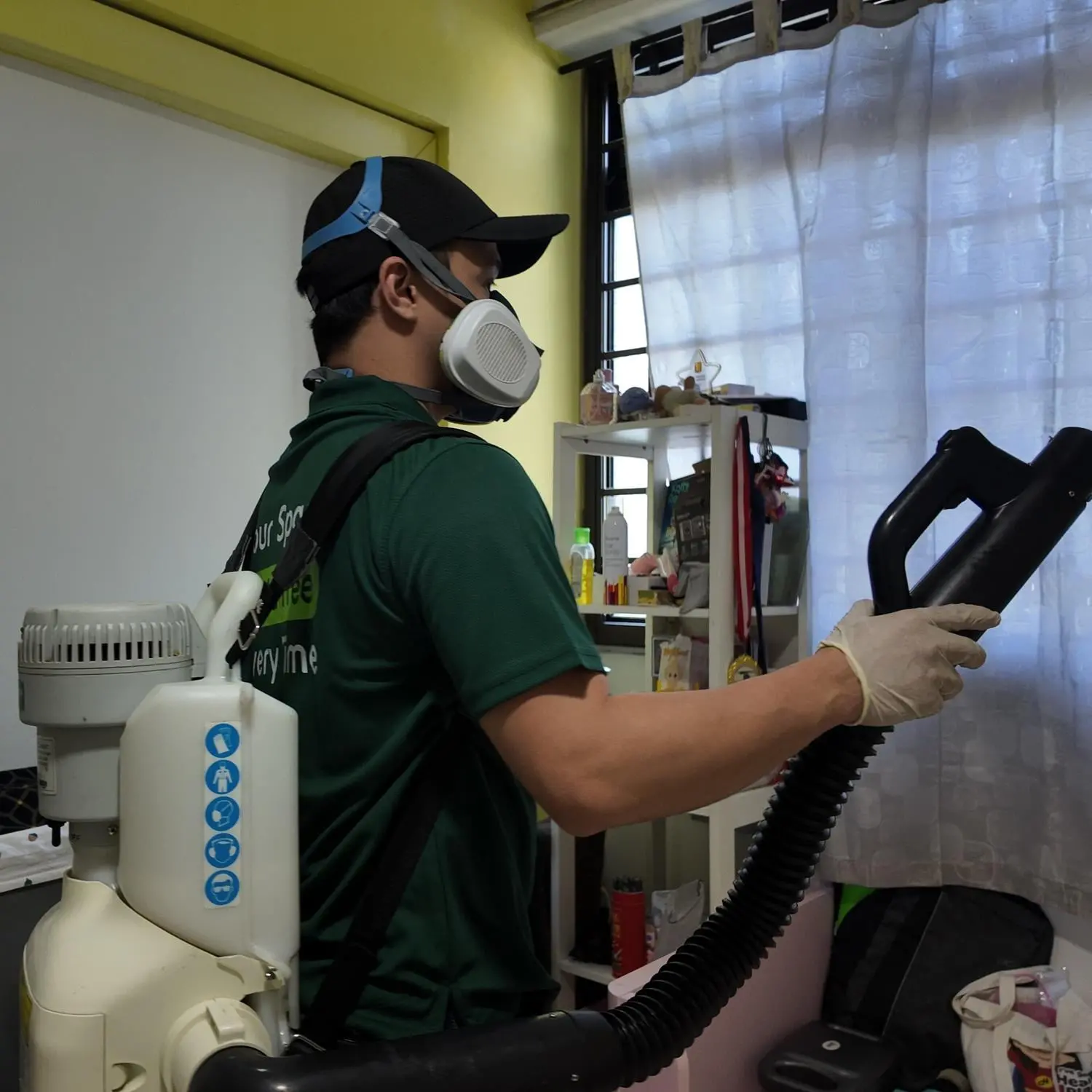
A trained decontamination team will:
- Seal off the work zone to prevent the spread of contaminants
- Apply NEA-listed products and ensure correct contact time (e.g., 10 minutes for a 1,000 ppm bleach solution)
- Only finish when on-site testing (ATP swabs, air quality readings) confirms the area meets local health standards
But that’s all when the true cause of contamination is already known.
In most cases, we’ve seen that house and building occupants are now aware of things like:
- Whether their premises are contaminated
- What is the nature and severity of the contamination
- What extent of decontamination treatment they require
As local specialists, we start every decontamination job by pinpointing the real threat. It can be viruses, mold, lingering VOCs, or a combination of these.
Then we remove the source, using only NEA-approved methods and products.
We only consider the decontamination work as finished until on-site tests confirm that air and surfaces meet Singapore’s strict health standards.
Your safety, and the safety of everyone who enters your space, is always our priority.
Professional Decontamination: Step-by-Step in Singapore
When routine cleaning won’t remove a risk, it’s time to bring in experienced professionals.
Our teams in Singapore follow a six-step decontamination process, fully compliant with NEA guidelines and always documented for your records:
- Hazard Assessment
Identify the type and extent of contamination (virus, mold, VOCs) with swabs and air quality meters. - Site Preparation & Isolation
Seal doors and vents, establish negative pressure, and mark clean entry paths to prevent contaminants from spreading. - Gross Cleaning
Remove debris and any unsalvageable items, ensuring that disinfectants reach all affected surfaces. - Targeted Treatment
Apply NEA-listed chemicals for the recommended dwell time. Run HEPA or carbon scrubbers if the risk is airborne. - Rinse & Residue Removal
Wipe away or neutralise any remaining films to prevent corrosive build-up or lingering odours. - Verification & Documentation
Re-test surfaces and air with ATP swabs or meters, then provide a full report with photos and data for your insurer or building manager.
These steps ensure everyone’s safety and give building owners clear proof that the space meets Singapore’s health limits before anyone returns.
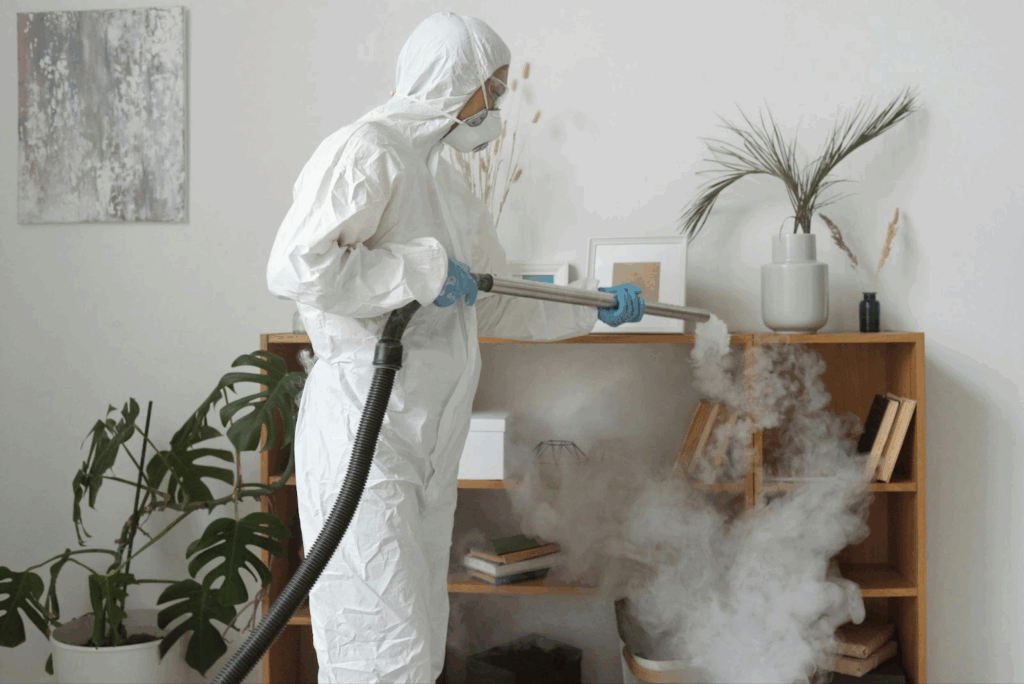
Common Situations Requiring Decontamination in Singapore
While most everyday messes and minor spills can be handled with cleaning and sanitising, certain events introduce risks that linger or spread if not addressed correctly.
If you’re unsure, consider calling a trusted provider like Mold Free in these scenarios:
1. After an Infectious Disease Case
A single positive case of COVID-19, HFMD, or norovirus can spark an outbreak overnight in shared offices or preschools.
In such cases. Singapore authorities recommend:
- Isolating the room and posting a notice
- Pre-cleaning visible dirt
- Disinfecting high-touch surfaces with freshly-mixed bleach (1,000 ppm, 10 minutes contact time)
- Proper disposal of wipes, gloves, and masks as infectious waste
After these steps, a quick ATP swab test helps confirm surfaces are safe for use again.
2. Mold After Leaks, Floods, or High Humidity
Mold can begin growing on wet materials within 48 hours.
Mold spores travel through vents, settling behind walls where you can’t reach with surface cleaning alone.
In this situation, a professional decontamination team is required to:
- Dry the area until relative humidity is below 60%
- Use HEPA air scrubbers and negative pressure to contain airborne spores
- Remove and safely dispose of wet plasterboard or affected materials
- Apply anti-mold treatments and conduct air or surface sampling to ensure safe spore levels
Without this thorough approach, mold return within weeks.
3. Biohazard Situations
Blood, sewage, or rodent droppings carry dangerous pathogens that survive and spread for days if not addressed correctly.
A proper biohazard decontamination in Singapore should include:
- Enclosing the work area with plastic sheeting
- Applying the correct NEA-listed disinfectant
- Running HEPA and carbon scrubbers for airborne contaminants
In such a situation, we also document every step, and produce a photo log and clearance note that satisfies insurers and your MCST or building manager.
4. Chemical or VOC Exposure After Renovation or Spills
New paint, carpentry, and adhesives are known to release formaldehyde and other volatile organic compounds (VOCs).
In these cases, our post-renovation decontamination starts with real-time indoor air quality (IAQ) readings and improves ventilation to at least six air changes per hour, for which we use carbon filters to trap harmful vapours.
We only finish the job when:
- Formaldehyde levels are below 0.08 ppm
- Carbon dioxide is below 700 ppm above outdoor levels
This approach protects everyone using the space, especially in Singapore’s tightly sealed buildings.
5. Fire or Heavy Smoke Residue
After a fire, soot and acidic particles stick to walls, electronics, and furnishings long after the flames are out.
A professional smoke clean-up begins with HEPA vacuuming to remove fine dust, followed by an alkaline wash to neutralise acids, and finishes with odour control.
To verify all corrosive dust is gone, we check air-particle counts and use surface wipes, so you can be confident your space is safe for reoccupation.
Wrapping Up
Decontamination isn’t just about strong chemicals. More than that it’s about certainty.
A space is truly safe only when testing equipment or a swab confirms it, and you have documentation to show for it.
If you engage a professional decontamination service, always ask:
- What tests will you run after treatment?
- Which NEA-listed decontaminants will you use?
- Will I receive a report for my insurer or MCST?
A reliable team will answer these questions transparently and provide you with full records.
If you’d like site-specific guidance or have questions about decontamination in Singapore, WhatsApp our specialists and we’ll walk you through the next practical steps
Frequently Asked Questions
1. What are the three main types of decontamination in Singapore?
In Singapore, decontamination is generally grouped into three types:
- Routine cleaning and sanitising, to keep everyday dirt and low-level microbes under control.
- Technical disinfection, which is used for outbreaks or mold, requiring the use of NEA-listed chemicals with precise contact times.
- Biohazard decontamination, which involves sealing off zones, using full PPE, and conducting on-site testing. This is needed for situations involving blood, sewage, hazardous chemicals (VOCs), or radiological risks.
2. How is biohazardous waste safely decontaminated and disposed of?
During biohazard decontamination, experts use high-level disinfectants to eliminate pathogens. Contaminated materials are then double-bagged in UN-rated liners and transported in sealed bins to an approved incineration plant. Complete disposal records are kept for audit and insurance compliance.
3. Which four methods are most used for professional decontamination?
Professionals rely on a combination of these four core methods:
- Dry removal (e.g., HEPA vacuuming)
- Chemical application (using NEA-listed disinfectants)
- Heat or steam treatments
Negative-air filtration to capture airborne contaminants
4. What’s the difference between sterilisation and decontamination?
Sterilisation aims for total elimination of all microorganisms, typically with the use of pressurised steam or plasma in medical settings.
Decontamination, however, is broader.
The goal here is to remove or neutralise specific hazards until the space meets health and safety limits, then verify the result with on-site testing.
For most Singapore homes and offices, decontamination is the practical, effective solution.
5. Decontamination vs disinfection: what’s the difference?
These terms are often used interchangeably but they’re not the same. Disinfection reduces germs on pre-cleaned surfaces to lower infection risk.
Decontamination goes further: it tackles hidden or airborne hazards, involves zone containment, and always ends with tests like ATP swabs or indoor air readings for assurance.
These extra steps provide greater safety, especially when the hazard could cause significant harm if left untreated.