is one of the most searched mold problems among Singapore homeowners, particularly in HDB flats. This article explains why ceilings develop mold differently from walls, the specific causes behind ceiling staining and spotting from roof leaks to aircon condensation to rising bathroom steam and why is generally riskier to handle yourself than wall mold. It closes with a practical breakdown of what’s reasonable to address on your own and when overhead mold needs a professional solution.
Table of Contents
Why Ceiling Mold Is So Common in Singapore Homes
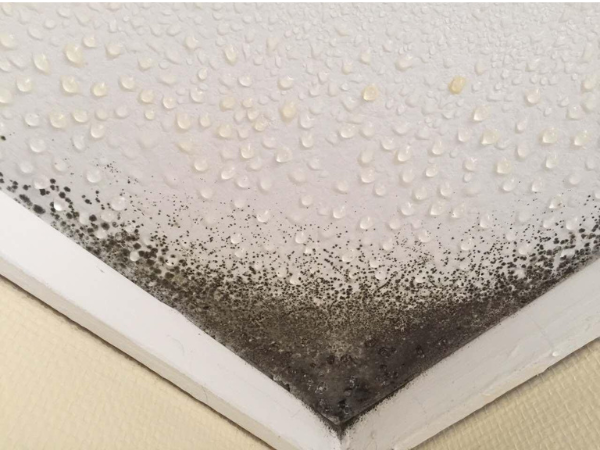
Ceilings collect rising warm, moist air more than any other surface in a room. Heat and humidity naturally move upward, and in an enclosed space without adequate ventilation, that moisture settles against the coolest available surface — which is very often the ceiling, especially directly above a heat source like a shower or stove. Combined with Singapore’s high ambient humidity, this makes ceilings, particularly in bathrooms and kitchens, one of the most consistently reported mold locations among Singapore homeowners — see our guide on what actually causes mold to grow for the underlying conditions behind this.
How Ceiling Mold Differs From Wall Mold
While walls and ceilings share many of the same underlying causes, ceiling mold behaves differently in a few important ways. Ceilings are more exposed to airborne moisture from below (steam, cooking vapor) and to water sources from above (roof leaks, upstairs plumbing, aircon drainage), giving it two directions of risk that a wall typically doesn’t face in the same way — see how mold appears on walls for the comparison. Ceiling surfaces also tend to be painted with materials chosen for overhead application, which can behave differently under sustained moisture than wall paint. And practically speaking, ceiling mold is harder to inspect closely and harder to treat safely, since it involves overhead work rather than a straightforward wall surface.
Common Causes of Ceiling Mold
Bathroom Steam and Poor Extraction
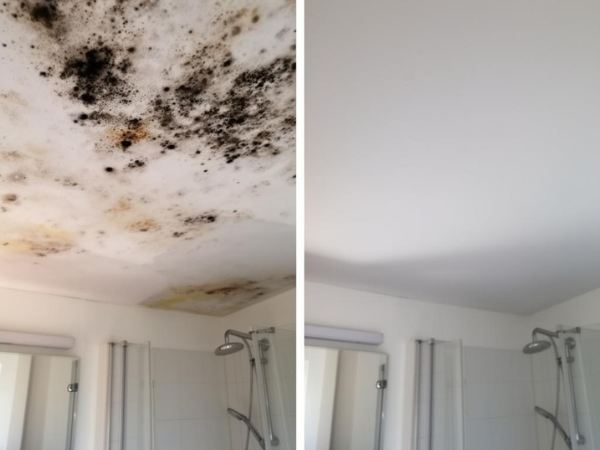
Daily showers release a significant amount of steam, and in bathrooms without windows or with undersized or poorly maintained exhaust fans, that moisture has nowhere to go except upward onto the ceiling. Over time, repeated exposure without adequate drying between uses creates ideal conditions for mold, particularly around the exhaust fan housing itself, where moisture tends to concentrate.
Roof Leaks and Water Ingress
In landed homes and top-floor units, a compromised roof cracked tiles, degraded flashing, or clogged gutters causing water backup can allow rainwater to seep into the ceiling structure. This type of ceiling mold is often accompanied by visible staining, a slightly sagging or bulging patch, or a stain that changes shape and size after heavy rain.
Aircon Condensation and Drainage Issues
Ceiling-mounted or wall-mounted aircon units generate condensation continuously during operation. If drainage lines are blocked, disconnected, or poorly sloped, that condensation can drip slowly into the ceiling space above, creating a hidden, ongoing moisture source that eventually shows up as a stain or mold patch directly beneath or around the unit. Indoor air quality testing can sometimes pick up on this before it’s visible as a stain.
Leaks From the Unit Above
In HDB flats and condos, a leak in the unit directly above — from a bathroom, kitchen, or washing machine connection — can travel through the floor slab and appear as staining or mold on your ceiling. This is one of the more frustrating causes to resolve, since it usually requires cooperation from the upstairs unit or building management to actually fix, even though the mold itself appears in your home.
Condensation From Temperature Differences
Ceilings adjacent to unconditioned roof spaces or exposed to significant day-night temperature swings can develop condensation purely from the temperature difference between the ceiling surface and the room’s air, without any leak at all. This is more common in top-floor units and landed homes with less insulation between the living space and the roof.
HDB Ceilings vs. Condo Ceilings vs. False Ceilings
Precast Concrete Ceilings (HDB and Older Condos)
Most HDB flats and many older condos have precast concrete ceiling slabs, finished with a skim coat and paint. Concrete is less porous than plasterboard, but it still holds and releases moisture slowly, which can create persistent surface condensation in poorly ventilated rooms. Joints between precast panels can also be a point of water entry if sealant has degraded.
Suspended or False Ceilings (Condos, Offices)
Many condos and commercial spaces use suspended (false) ceilings, typically gypsum board panels hung below the actual structural ceiling. These create a hidden void where pipes, wiring, and ducting run — and where leaks or condensation can pool completely out of sight until they either stain the visible panel below or cause it to sag. False ceilings are also more porous than concrete, meaning mold can spread within the panel material itself once moisture is present — this is one of several hidden places mold can grow that a routine visual check won’t catch.
Reading the Pattern: What Ceiling Mold Location Tells You
- Directly above a shower or stove — Usually steam and poor ventilation
- Around an exhaust fan or light fixture — Often condensation concentrating around the fixture, or a small leak at the fixture’s ceiling penetration
- Near a wall-mounted or ceiling aircon unit — Likely condensation or drainage issues
- In an irregular patch with visible staining that grows after rain — Suggests a roof leak or water ingress from above
- A perfectly localized spot beneath a specific fixture upstairs (like a bathroom) — Points toward a leak in the unit above
This pattern-reading isn’t a substitute for a proper inspection, but it’s a useful first step in understanding whether the cause is likely to be something manageable (ventilation) or something that needs outside involvement (a leak from another unit or the roof).
Why Ceiling Mold Is Riskier to Handle Yourself
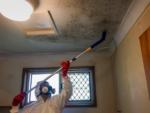
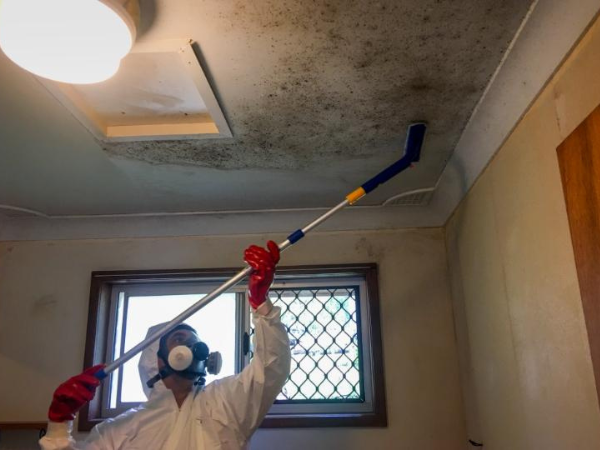
Ceiling mold carries a few extra risks that wall mold doesn’t. Overhead cleaning means any disturbed spores fall down into the room and toward your face, rather than away from you as they would on a vertical wall surface. Ceilings are also harder to inspect closely without proper equipment or scaffolding, which makes it harder to judge how far a problem actually extends. And because ceiling mold is frequently linked to a source above the ceiling line — roofing, upstairs plumbing, or aircon drainage — surface cleaning very often doesn’t address the actual cause at all, meaning it’s likely to return even after a seemingly successful clean.
Early Signs Before Mold Becomes Visible
- A yellow or brownish tinge appearing before any dark spotting develops
- Paint that looks slightly glossy, bubbled, or uneven in one section of the ceiling
- A musty smell noticeable when entering the room, particularly after the aircon or exhaust fan has been off for a while — if it lingers even after the room airs out, see what else commonly causes persistent household odours or consider professional odor removal
- A faint ring or halo pattern around a light fixture or exhaust fan, which often indicates moisture pooling at that point
Catching these early signs before mold becomes visibly established can make the eventual fix considerably simpler.
DIY Ceiling Mold Cleaning: What’s Actually Reasonable
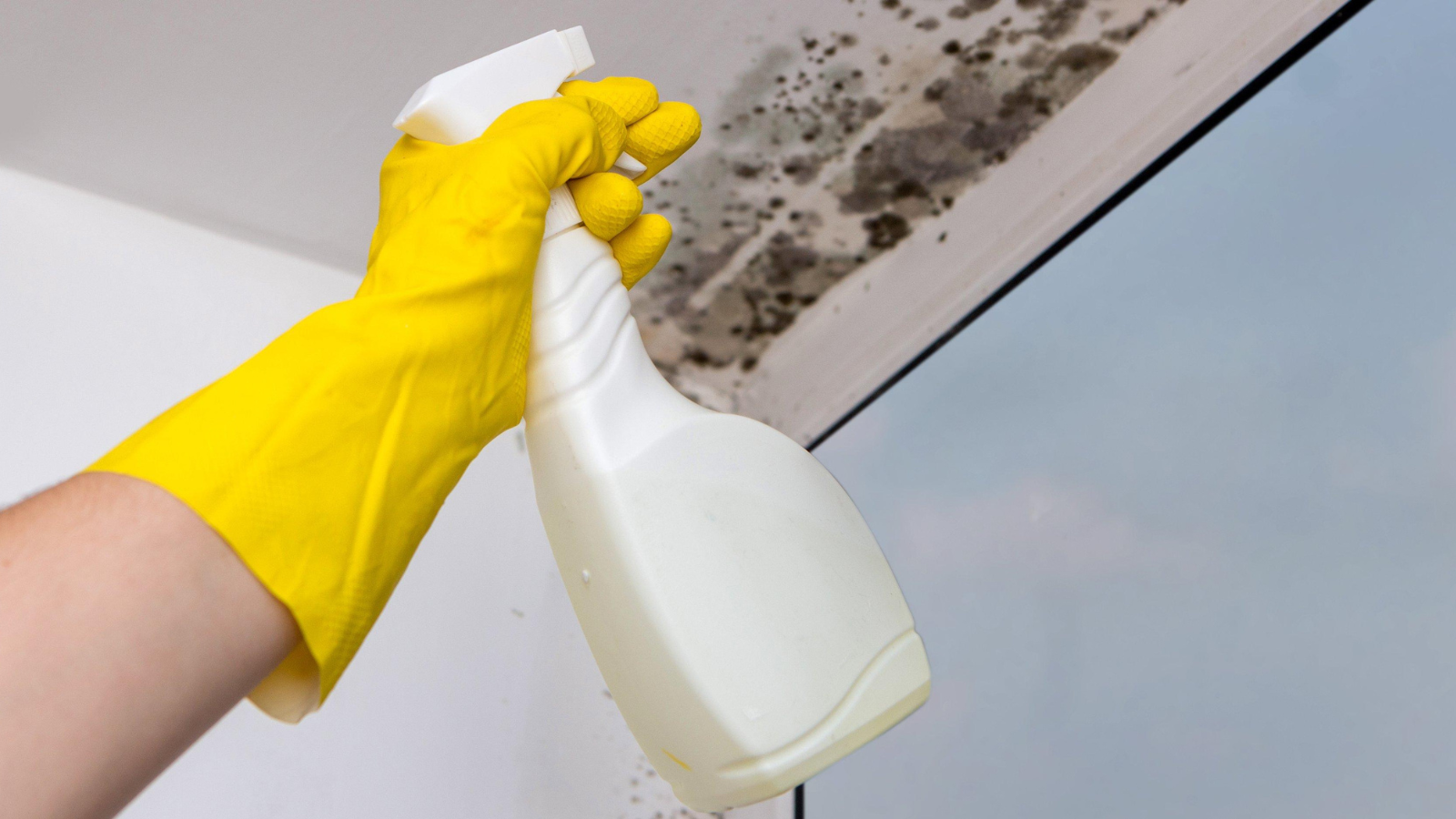
For very small, early-stage spotting on a hard, painted ceiling surface, with a clear and easily fixed cause (for example, a bathroom that’s simply been under-ventilated), light cleaning combined with improving ventilation going forward can sometimes be enough. This should always be done with the room ventilated, without aggressive scrubbing that could release spores, and ideally with the cleaner positioned to avoid direct exposure to falling debris or spray.
Beyond that, ceiling mold generally isn’t a strong DIY candidate. Any mold associated with staining, bulging, a suspected leak from above, or an area larger than a small, isolated spot should be treated as a signal to get a professional assessment rather than attempting repeated cleaning.
When Ceiling Mold Needs a Professional Solution
Professional involvement is the more sensible option when:
- The mold is accompanied by staining, sagging, or a bulging patch
- The affected area is large or has grown since it was first noticed
- The cause isn’t obvious or involves a suspected leak from a roof or the unit above
- Cleaning has been tried before and the mold returned
- The ceiling is a false/suspended ceiling, where the visible panel may only be showing part of a larger hidden problem
A professional assessment typically identifies whether the cause is ventilation-related, condensation-related, or an actual leak, which determines whether the right fix is improved extraction and a surface treatment, or something that needs to involve the roof, plumbing, or the unit above.Mold Free’s mold removal service includes this diagnostic step as standard, rather than treating the visible stain without knowing what’s causing it.
FAQs About Ceiling Mold
1. Why does mold keep appearing on my bathroom ceiling even though I clean regularly?
This is usually a ventilation issue rather than a cleaning issue. If the exhaust fan is undersized, poorly maintained, or not run long enough after showers, steam continues to settle on the ceiling regardless of how often it’s cleaned.
2. Is ceiling mold more dangerous than wall mold?
Ceiling mold isn’t inherently more dangerous in terms of health risk, but it’s riskier to clean yourself because disturbed spores fall downward into the room, and it’s more often linked to a hidden cause above the ceiling line.
3. Can a leak from the unit above cause mold on my ceiling?
Yes. In HDB flats and condos, a leak in the unit directly above can travel through the floor slab and appear as mold or staining on your ceiling, even if there’s no issue within your own unit. This is one of the clearer signs that it’s time to call a mold removal company rather than repeatedly cleaning the same spot.
4. How can I tell if ceiling mold is from a roof leak or just condensation?
Roof-leak-related mold is often accompanied by visible staining that changes after heavy rain, or a slightly sagging or bulging patch. Condensation-related mold tends to appear more gradually without those additional signs.
5. Is it safe to clean mold off a ceiling myself?
Small, early-stage spots on a hard, painted surface with an obvious, fixable cause can sometimes be cleaned safely with proper ventilation and care. Larger areas, staining, or an unclear cause are better handled by a professional — see our comparison of DIY vs professional mold removal for a fuller breakdown of where that line sits.
6. Do false ceilings hide bigger mold problems than what’s visible?
Often, yes. A stain or spot on a suspended ceiling panel may only represent part of a larger issue happening in the void above, where pipes, wiring, and ducting run out of sight — the same reasoning covered in our guide to hidden places mold can grow.
7. What’s the first thing I should check if I notice ceiling mold?
Consider the location: mold directly above a shower or stove usually points to ventilation, while an irregular patch that grows after rain points toward a leak. This can help you gauge whether it’s a quick fix or something needing a professional look.